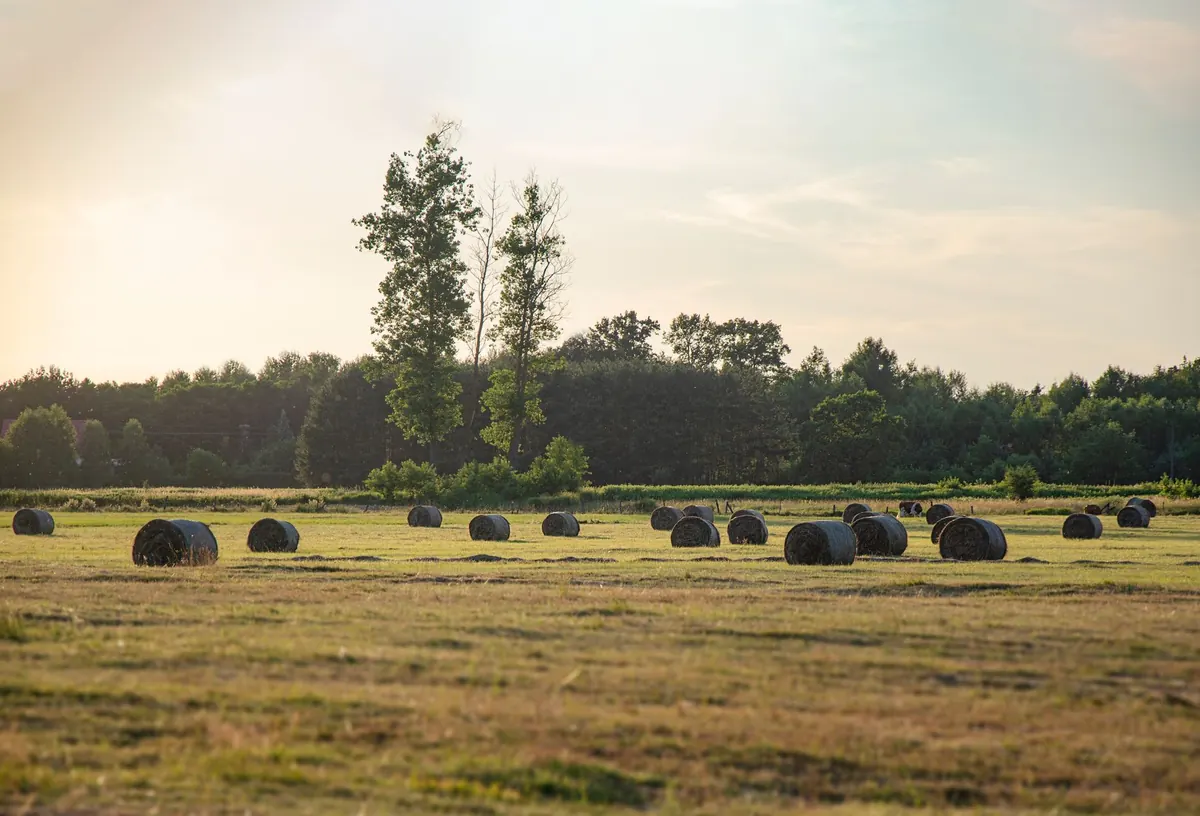
You can usually smell a good hay day before you can name it. The grass is dry underfoot by eight, the sky has that pale, washed-out quality near the horizon, and the air feels lighter than it did at dawn. Nothing on a forecast page tells you that. Standing at the gate with a mug in your hand, you learn to read it — and to notice when the reading changes.
Short dry windows are the whole game in meadow work. You are not waiting for a settled week; you are looking for two or three honest days, or even one long afternoon, and the signs that tell you whether the air is going to give them to you or take them back. What follows is the set of visual checks worth building into the morning, in rough order of how much they tell you.
Haze That Burns Off and Haze That Settles In
Morning haze is not one thing. There is the thin, blue-grey haze that sits in the low ground at sunrise and is gone by half past nine. That haze is a good sign: the air is calm and damp at ground level, but there is dry air above it, and the sun is strong enough to lift the moisture out. Hay dries fast on days that begin like that.
The other kind is softer and milkier, and it spreads upward instead of thinning. It usually survives until eleven, then noon, then it starts to look like the front edge of something rather than the tail end. Watch the far side of the valley: if the fields across the way stay hazy when your own are clear, moisture is still sitting in the middle distance and the day will close earlier than you hoped.
A useful rule of thumb: haze that shrinks is drying weather; haze that thickens is weather arriving. You only need to check it twice, once at seven and once at ten, to know which you have.
Clouds Worth Trusting
Cumulus clouds are the honest ones. Small, flat-bottomed and well spaced in the late morning means the air is stable and the afternoon will stay bright. Watch what happens between eleven and two. If those same clouds stay small and drift apart, keep cutting. If they start building towers, thickening bases and casting shadows on each other, the afternoon is being reorganised.
Signs in the high cloud
Look up rather than across. Streaks of cirrus, particularly when they thicken into a veil and begin to form a faint ring around the sun or moon, mean moisture is arriving high up. That is often a day or more ahead of any rain, so it is not an emergency — but it does mean the window is shorter than a clear sky would suggest.
A halo is the clearest of these signals and worth teaching to anyone who works alongside you. So is the way the sky at the western horizon loses its clean edge in the evening. A crisp sunset is a promise; a sunset that fades into a grey smear is a question mark.
Dew, Cobwebs and the Grass Underfoot
Heavy dew after a clear night is normal and does not contradict a dry forecast. What matters is how quickly it lifts. Walk the same strip at seven and again at nine. Grass that wets your boots at seven and is dry by nine, with the tractor tyres leaving no dark tracks, is grass on a drying curve.
Spider webs are the cheapest instrument you own. A web holding beads of water at eight in the morning and dry by ten tells you the air has room in it. Webs that stay beaded into the afternoon mean the air is close to saturation and nothing is going to dry properly, whatever the sky looks like.
Check the underside of the swath as well as the top. A hay crop can look and feel dry on the surface while the stems beneath the windrow are still cool and limp. Turn a forkful over with your boot and put the back of your hand against it. Cold and damp is a no; warm and papery is a yes.
Wind, Smoke and the Direction of the Day
A light, steady breeze is the best drying tool on the farm — better than a still, hot day, which only bakes the surface. Watch the smoke from a chimney or a bonfire. Smoke that rises straight and thin then drifts gently sideways is ideal. Smoke that hangs, curls and spreads low means the air is heavy and drying will be slow.
Wind direction matters more than wind strength. A shift that backs round during the morning, especially if the breeze freshens while it turns, often marks a change of air mass. If you are halfway through a field when it happens, finish the bout and hold off on mowing anything new.
The scent of the air belongs here too. That sudden clean, mineral smell on dry ground — often strongest before a shower — is a warning, not an invitation. So is the moment the wind drops completely at the end of a hot afternoon when it had been blowing steadily all day. Calm arriving at four in the afternoon usually means pressure is changing, and the evening will not be as generous as the morning was.
Distance, Colour and the Far Hills
Visibility is an underrated gauge. When the hills ten miles off look sharply cut and slightly darker than the sky, the air is dry and you have time. When they soften, turn bluish and seem to move closer, moisture is building. Old hands describe it as the hills coming in for a visit; when they arrive, the mower goes back in the shed.
Colour in the grass itself helps as well. Cut hay that looks a dull olive in the swath is holding moisture; hay that turns a pale, strawy gold within a few hours of turning is not. Leaf shatter is the same message in miniature — if the leaves crumble off the stems as you handle a handful, you are close to baling. If they stay pliable and folded, you are not, no matter how hot your neck feels.
Three Field Tests Before You Bale
None of these replaces a moisture meter, and anyone baling seriously should own one. The exact safe figure depends on bale type, size and density, so take local advice rather than a number off a page. But the eye and the hand will get you most of the way there.
- The twist test. Take a good handful of stems, twist them firmly and let go. If they spring back and sound dry, the crop is close. If they stay twisted like a rope and feel cool, leave it another few hours.
- The knot test. Take a stem with a seed head and bend it into a knot. Stems that snap are drier than stems that fold quietly.
- The shake test. Shake a forkful over a clean patch of stubble. A cloud of leaf and dust means the leaf is cured. Very little means the plant is still holding together.
Signs the Window Is Closing
Any two of these together is enough to stop cutting and start protecting what you already have:
- Haze thickening after ten o'clock instead of thinning.
- Cumulus building early and flattening into sheets by midday.
- Dew that lingers past ten, or webs still beaded in the afternoon.
- A backing wind, or a sudden dead calm at the end of a breezy day.
- The far hills losing their sharp edge.
- A halo round the sun, or high cloud thickening into a veil.
A Five-Minute Routine Before You Start the Tractor
Look at the far hills, then the horizon, then straight up. Check the dew on the grass under the hedge, where it lingers longest. Turn a forkful of yesterday's swath and feel the underside with your hand. Light a match and watch the smoke. Five minutes, no instruments, and you will know more about the next eight hours than you did with the coffee in your hand.
Write it down. A line in a notebook each morning — haze, wind, dew, hills, what happened by evening — builds a record that is worth more to your own ground than any general forecast, because it is calibrated to the way weather behaves in your valley, on your slope, above your hedges. Haymaking has always been a conversation between the field and the person working it. The signs are there every morning; the skill is only in learning to answer.
Photo: Piotrek Wilk / Pexels